Quality Learning
March 21, 2023
5 min read
Hello guys 👋,
Welcome to this week's article.
You certainly gained a lot from last week's benchmarking; make it a duty to practice what you learnt, and you will be amazed at the results.
This week's menu....😋
This week, we will look into Quality Learning, its concepts, types, and how to apply it.
An Introduction....
In learning, individuals can modify their perspective to embrace the continual development of vital knowledge and skills to pursue total professionalism.
For a learning process to be effective, it must be constantly updated and provide continual feedback.
As a result, an effective learning process for individuals and organizations should centre on the quality of feedback provided by the parties involved.
The willingness to learn the skills, implement them, and practice them in an appropriate situation is thus necessary for any effective learning process.
On the other hand, continuous learning necessitates a persistent interest in learning over time and refers to the progress in learning ability independent of the information being taught.
Brower, in 1994, gave his thoughts on the product of education:
The product of education is a person empowered to educate herself or himself— an educating person not an educated person.
In today's world, no one can ever be genuinely educated. What a person learns in a short period, say three years, will certainly be outdated after a few years.
The important word in connection to continuous improvement is learning. As a result, the learning process is the most crucial aspect of continuous improvement.
We would now move on to the next parts, discussing different learning processes and how to develop a learning path for continuous development as a quality person.
Continuous Learning
There is a widespread misperception that learning concerning a professional career stops when full-time education ends. This education could be at the bachelor's, master's, or doctorate levels. The reality, however, could only be further from this.
The major learning approaches are as follows:
- studying for professional membership examinations, e.g., quality management;
- full-time or part-time study for first degree, master's, and doctorate degrees by research and study, e.g., BSc, MSc, MBA, MPhil, and Ph.D.;
- learning at work.
Common Learning
When a teacher provides knowledge, it is frequently considered that learning is closely related to the teaching process. The assimilation of the information is subsequently put to use in the proper tasks. Today, it is believed that this is not the case. Real learning is largely accomplished through experience. This type of learning is a hands-on experience. A typical learning cycle exists (Korb's cycle of experiential learning), as shown in figure below.
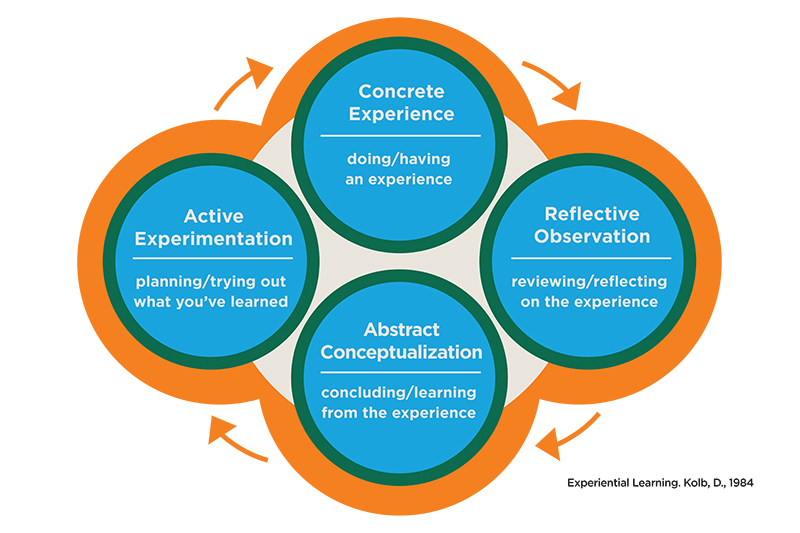
Source: Levett-Jones (2017)
The feedback component is crucial; it involves taking action, observing the outcome, and changing behaviour as needed.
All phases of this cycle must be experienced if true learning is to take place.
Effective Learning
Making sure that learning is effective is necessary. An individual or organization will have negative effects if learning is not taken seriously.
An effective learning method is likely to incorporate the following:
- know how and why people learn.
- foster a positive learning atmosphere.
- determine the individual's learning requirements.
- create a learning plan with agreed-upon goals.
- encourage opportunities for learning.
- review learning results.
Quality Learning
We have briefly discussed the learning cycle and how people acquire knowledge. Each cycle stage must be completed if people are to learn truly.
We must position this cycle of learning inside the corporation, educational setting, or personal lives.
Each cycle must be finished and uninterrupted for development to occur.
Let us now look at the continuous quality learning process, which encompasses all of an organization's operations.
In general, quality learning is a continual process that can be examined at any point in an organization's supply and customer service learning systems.
We will explore it using the PDCA cycle (See figure below).
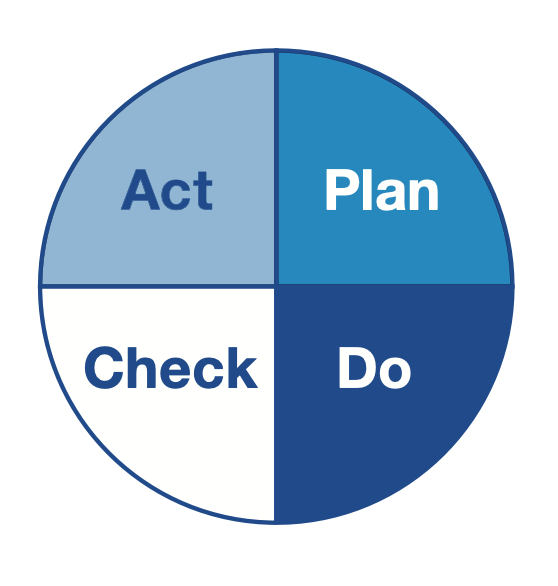
Source: Lean Enterprise Institute
In the PDCA cycle, Plan outlines the learning process, which assures documentation and establishes measurable objectives against it. The Do implements the process and gathers the necessary information and knowledge. The Check evaluates the data in an appropriate format. The Act requires corrective action and evaluates plans using quality learning methodologies and processes. The procedure is either standardized, or learning targets are altered based on the analysis at the end of each cycle, and the cycle repeats.
Finally, applying quality learning through a learning plan...📑
Before creating a realistic learning plan for yourself (or someone else), you must examine your learning needs and the desired learning objectives for yourself or the other party.
First, identify the learning needs and determine the information, skills, and attitude required for a certain task or function to be done successfully. Against this list, the individual's knowledge, skills, and attitude should be examined (or yours, whichever case applies). The learning gap is the difference between these two lists. An honest dialogue with and agreement from the individual concerned should be part of identifying learning requirements. If you have to create a strategy for a specific person, you will almost certainly have to engage in an open discussion with that person and come to an agreement with them.
Learning outcomes explain what an individual can and how well they can do due to the learning process. There should be a list of expected outcomes regarding behaviour and performance. The required criteria should also be developed to measure the effectiveness and level of learning. This learning process should also have a time range.
Thus, the learning plan is a synthesis of learning demands and learning outcomes. This strategy, which is best written down, should be agreed upon by both the individual and their trainer (if you crafted the learning journey, consider having an accountability partner). The plan should adhere to the learning cycle and thus include a list of intended objectives, with activities required to achieve the desired outcomes. A resource and specific training requirements may have been determined at this point. This process can be considered the cycle's planning stage. Following the completion of the learning experience, some reflection/assessment should occur.
The learning cycle concludes with conclusions-based reflection and assessment input into reformulating and improving the next planning step of the learning cycle. The process continues indefinitely...
Wow! We have already learnt so much in a short space of time...🔥💪
Do not forget to practice what you have learnt...😉
See you soon!😎
Sources
Brower, M.J. (1994) The paradigim shifts required to apply TQM and teams in higher education, in Readings in Total Quality Management (ed. H. Costin), The Dryden Press, New York, USA.
Jens, J.H., Kai, K., and Gopal, K.K. (2007). Fundamentals of Total Quality Management. Taylor & Francis Group, New York and London.
Levett-Jones, T. L. (2007). Facilitating reflective practice and self-assessment of competence through the use of narratives. Nurse Education in Practice, 7(2), 112–119. https://doi.org/10.1016/j.nepr.2006.10.002