

Benchmarking
March 12, 2023
7 min read

Hello there👋,
Welcome to the ASQ Unilorin article page. You're making history as one of the first to read the maiden article of the academic year.
Cheers!🥂
In this article, we'll be looking at: a brief history of benchmarking; the definitions of benchmarking and its types; and how to apply it in our daily lives.
Without much ado, let's dive right into it 👇
Firstly, a bit of history....
Rank Xerox was doing well in the 1960s. The company had developed a novel product, the photocopying machine, which became a source of massive profit. The business debuted in the Fortune 500 Companies in 1962 at position 423 and rose all the way to position 70 in 1970. This giant stride made by the company made it 'rest on its oars,' so much that it forgot to keep an eye on its competitors. Also, the company lost much of its fortune on adventures outside the core business and lost control of vital functions such as product development and production. But the situation reached its climax when Canon, a competitor, declared open war with Xerox in an advertisement of 12 January 1981 titled, Waging total war on Xerox. This confrontation happened because Xerox was an easy target for such direct attack. Danger loomed, but Xerox snapped out of their euphoria, determined not to accept the attack. The circumstance prompted the managing director at the time, Mr. David Kearns, to declare, 'We are determined to change significantly the way we have been doing business.'
The business would then be directed to the following quote by the Chinese philosopher Sun Tzu, who lived around 500 BC:
If you know your enemy and know yourself, you need not fear the result of a hundred battles.
The statement served as the foundation for Xerox's subsequent tactics. They would then engage in battles with the rivals by methodically gathering data about the market, the rivals, and themselves in order to plan the strategies and tactics required to win the declared war. This procedure was the main reason behind Rank Xerox's ride against the tide and regaining the lost market shares. They called this procedure benchmarking.
What is Benchmarking?
Two things form the core of benchmarking, which are:
- Sun Tzu's rule of the art of good war: 'To know yourself and your enemy.'
- An ancient Japanese word DANTOTSU, which means striving towards becoming the best of the best.
These core principles are found in Mr. David Kearns' definition of benchmarking:
Benchmarking is the continuous process of measuring products, services, and practices against the toughest competitors or those companies recognized as industry leaders.
In 1992, American Productivity and Quality Center provided a detailed definition of benchmarking, which is stated as thus:
Benchmarking is a systematic and continuous measurement process; a process of continuously measuring and comparing an organization's business processes against business process leaders anywhere in the world to gain information that will help the organization take action to improve its performance.
NOTE😮:
At this point, we should note that benchmarking and copying are two distinct concepts. The difference is so because understanding the 'theory' behind the solutions used by the other parties forms the basis of benchmarking.
What are the types of Benchmarking?
Dependent on the object of analysis, benchmarking is typically divided into the following three types:
- Internal benchmarking
- Competitor benchmarking
- Functional/generic benchmarking.
The objects of analysis of internal benchmarking are departments, divisions, or sister companies of the same concern to identify the best performance of a given activity within the company. Such activities include order booking, stocking, distribution, and product development.
The advantages of internal benchmarking are that it:
- improves data and information sharing within an organization.
- improves the ability to communicate and co-operate in the company.
- improves internal performance and customer satisfaction by reducing variations in quality and productivity.
In competitor benchmarking, the company compares itself directly to the present and potential competitors within the same range of products (e.g., competitors in foreign markets) to gather information on their products and processes. It compares this information with the company's results and learns from the differences.
The advantages of competitive benchmarking include the following:
- being able to deduce customers' expectations of a particular product very early.
- the results have a high degree of comparability as the products and the primary production structures are identical.
However, the limitation of this type of benchmarking is that data gathering can take time and effort.
In functional/generic benchmarking, the prospective comparative partner is any organization with a reputation for being excellent in the benchmarked area. In this instance, the corporation does not have to limit itself to its trade but rather keeps an eye out for 'best practices' everywhere. If you want to examine order dispatch, for example, it may be logical to compare with a mailing company or other companies that handle a great deal of orders on a daily basis.
The advantages of functional benchmarking are:
- As the number of prospective benchmarking partners increases, so does the likelihood of identifying world-class practice.
- Since it is far simpler to establish collaboration with businesses in industries other than your own, data collecting in this scenario is much simpler than competitive benchmarking.
The Benchmarking Process
We shall now examine how benchmarking is carried out with another continuous improvement tool: the PDCA cycle (Plan Do Check Act).
So benchmarking will be carried out in 4 stages:
- PLAN: Planning
- DO: investigate and observe
- CHECK: examine the outcomes.
- ACT: Adapt findings and continue to improve.
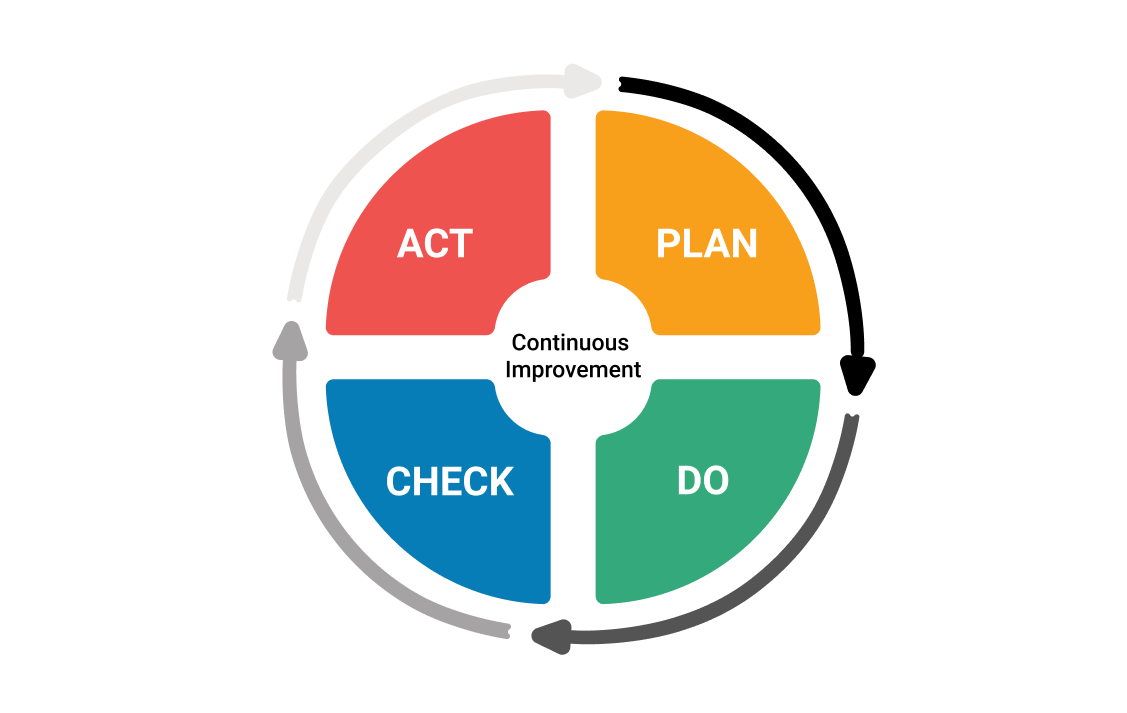
Source: kabanize
The planning stage (Plan) encompasses deciding what will be benchmarked, the standards for choosing benchmarking partners, the procedures for gathering data, and the use of resources.
The Do stage entails establishing a specific choice of benchmarking partners and gathering data.
The Check step includes data correction, finding and measuring knowledge gaps, and determining the reasons for the knowledge gaps.
The final phase, known as the Act stage, entails the following activities: communicating the results discovered, adapting the results to one's situation and organizing functional goals, creating an action plan, and carrying out the action plan.
The bottom line, applying benchmarking to our daily lives…
It's been an exciting ride so far, but this point of the journey begs a critical question: How do we translate the purpose of benchmarks to our lives as a whole?🤔
First off, it's important to avoid defining success in terms of standards established by other people because doing so would make it difficult to feel content or pleased. We'll always be chasing after someone who has more money, a nicer car, or higher grades.
By defining and maintaining awareness of our goals, values, priorities, and ultimately, what we view as the meaning of our life, we can establish our benchmark. Everything we do throughout our life is guided by all of these things. We can more effectively use our time, money, skills, and effort if we can recognize those things and work toward them continually.
That doesn't mean we should just define goals that are easily reachable. It simply means that we must set goals that are consistent with our values and priorities. We will not always fulfill our own expectations, but that is acceptable. Ultimately our level of happiness depends on our ability to set appropriate benchmarks.
Many thanks for taking the time to read this article. As we progress in the academic year, anticipate insightful and educative articles from ASQ Unilorin.
See you soon!😎
Sources
Askarany, D., & Yazdifar, H. (2015). Attributes of Adopters and the Diffusion of Benchmarking. Journal of Applied Management Accounting Research, 13(2), 45.
Benchmarking - Essays, Research Papers and Articles on Business Management. https://www.businessmanagementideas.com/management/benchmarking/benchmarking/21308
Book Summary: The Art of War by Sun Tzu - James Clear. https://jamesclear.com/book-summaries/the-art-of-war
Jens, J.H., Kai, K., and Gopal, K.K. (2007). Fundamentals of Total Quality Management. Taylor & Francis Group, New York and London.
The contribution of benchmarking to quality improvement in healthcare .... https://bmchealthservres.biomedcentral.com/articles/10.1186/s12913-022-07467-8